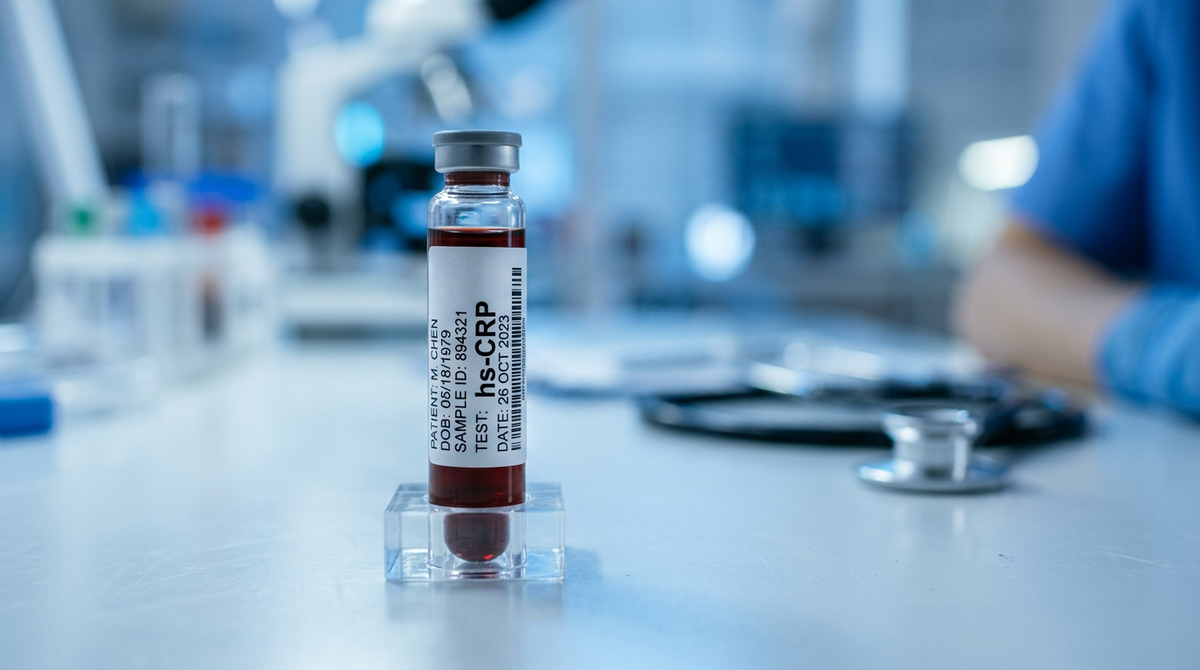
Most people only go for blood tests when something already feels wrong.
But inflammation inside your arteries does not always come with symptoms. It quietly builds over months or years, and by the time chest pain or a cardiac event occurs, the damage is already done.
That is exactly why the hs-CRP test exists.
It catches what a basic checkup misses and gives your doctor a much earlier window to act.
What Is hs-CRP?
CRP stands for C-Reactive Protein. It is a protein your liver produces whenever there is inflammation in the body.
The "hs" in hs-CRP stands for high-sensitivity. The standard CRP test detects major inflammation like infections or injuries. The hs-CRP test is designed to pick up very low-level, chronic inflammation, the kind that silently damages your cardiovascular system over time.
This is a critical difference. Low-grade inflammation at levels below what a standard CRP test can detect is still enough to accelerate plaque buildup in arteries.
The hs-CRP test has a detection range 10 times more sensitive than a regular CRP test.
Why Does Chronic Inflammation Matter for Your Heart?
Inflammation is not always the enemy. Acute inflammation helps your body heal wounds and fight infections.
The problem is chronic, low-grade inflammation, which is a slow burn that never fully turns off.
When this kind of inflammation is present in blood vessel walls, it contributes to atherosclerosis, the gradual hardening and narrowing of arteries. This raises the risk of heart attack and stroke.
According to the World Health Organization, cardiovascular diseases are the leading cause of death globally, accounting for approximately 17.9 million deaths every year. A significant portion of these are linked to modifiable risk factors, including systemic inflammation.
In India specifically, heart disease is occurring at younger ages compared to Western populations, often a decade or more earlier. Many of these individuals had no warning signs at all.

What Do hs-CRP Levels Actually Mean?
The results are typically read in milligrams per litre (mg/L):

These are risk stratification values, not a diagnosis on their own. Your doctor will interpret hs-CRP alongside your cholesterol levels, blood pressure, family history, and lifestyle factors.
Who Should Get the hs-CRP Test?
The hs-CRP test is recommended for:
- Adults aged 30 and above with no known heart condition but risk factors like obesity, smoking, or family history of cardiac events
- People with borderline-high cholesterol who need better risk classification
- Individuals with diabetes or metabolic syndrome
- Anyone who has already had a cardiac event and needs ongoing monitoring
- Patients with unexplained fatigue, joint pain, or recurring inflammation
You do not need to wait for symptoms. The whole purpose of hs-CRP is to act before symptoms appear.
hs-CRP and Lipid Profile Together
An hs-CRP result becomes far more useful when paired with a Lipid Profile.
Cholesterol tests show you the amount of fats circulating in your blood. hs-CRP shows whether those fats are causing inflammation in your artery walls. Together, they give your doctor a complete picture of cardiac risk that neither test can provide alone.
If your LDL is borderline and your hs-CRP is elevated, your risk profile is significantly worse than if only one marker were abnormal.
This combination is now considered a gold standard for non-invasive cardiac risk assessment.

Recommended Tests
How to Prepare for the hs-CRP Test
The hs-CRP test requires a simple blood draw. Most labs ask for an overnight fast of 8 to 12 hours, though some do not require fasting at all.
You should avoid intense physical exercise in the 24 hours before the test, as exercise temporarily raises CRP levels and can affect results.
If you are currently dealing with an active infection, cold, or flu, reschedule the test. Acute infection spikes CRP dramatically and will make cardiac risk assessment inaccurate.
Know your inflammation levels before they know you.
Book a home sample collection for hs-CRP and Lipid Profile. No clinic visits, no queues. Our trained phlebotomist comes to your doorstep at a time that works for you.